Quick answer
Wood railings offer a traditional look and flexible detailing but require periodic finishing. Aluminum railings provide clean lines and low maintenance. Cable systems preserve views but require engineered components, correct tension, and code-compliant spacing. Composite railings coordinate with composite decking and reduce painting but can have larger profiles and higher material cost. The best system fits the home, view, maintenance preference, budget, and approved installation requirements.
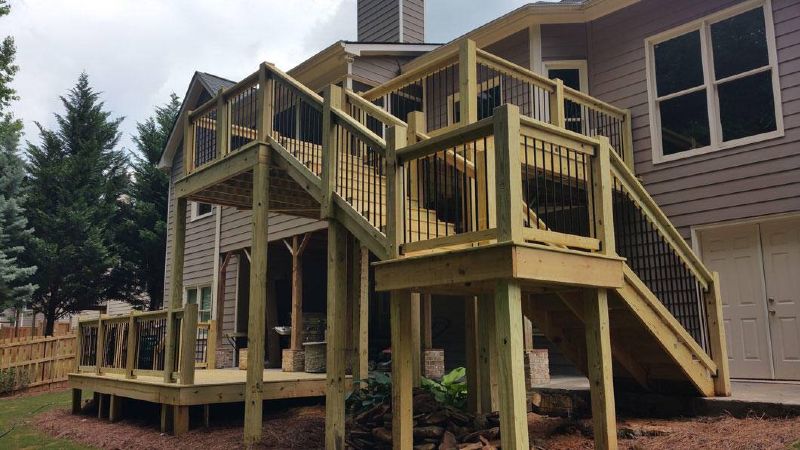
A Deck Railing Is a Safety System First
Guards help prevent falls from elevated walking surfaces, while handrails provide a graspable support along stairs. The terms are related but not interchangeable. Required height, openings, loads, handrail shape, and stair details depend on the adopted code and project conditions.
A beautiful top rail cannot compensate for weak post connections. Guard posts often transfer significant force into the deck frame, so blocking, bolts, hardware, rim condition, and stair attachment must be planned as a system.
When replacing rails on an older deck, evaluate the supporting frame rather than attaching a new product to deteriorated or inadequate wood.
Wood Deck Railings
Wood railings can match a traditional deck, support custom profiles, and keep the initial material choice familiar. Posts, rails, and balusters can be stained to coordinate with the deck or painted for contrast.
Best qualities
- Natural appearance
- Flexible custom detailing
- Individual components can often be repaired
- Works naturally with pressure-treated or cedar decks
Considerations
- Periodic cleaning and finishing
- Potential checking, twisting, splintering, and decay
- More visual mass than thin metal systems
- Connections and end grain need good water management
Aluminum Deck Railings
Powder-coated aluminum creates a slim, consistent railing with minimal routine maintenance. Black is popular because it tends to recede visually, but other finishes may better match the home and decking.
Aluminum is resistant to rot and does not need staining. Systems use manufacturer-specific posts, brackets, rails, balusters, and fasteners. Scratched finishes, dissimilar-metal contact, installation tolerances, and stair transitions should be handled according to product instructions.
This is often a strong option for homeowners who want an open view without the tensioning requirements of cable.
Cable Deck Railings
Cable railings use horizontal or occasionally vertical stainless-steel cable within a designed post-and-frame system. The narrow infill helps preserve views across wooded, lake-area, or landscaped properties.
Cable is not simply wire stretched between ordinary posts. Post spacing, frame stiffness, terminal hardware, tension, corners, stairs, and opening limitations are part of an engineered system. Cables may require periodic adjustment, and horizontal lines may not suit every household or local interpretation.
Use approved components and verify the complete system with the permitting authority.
Composite and Vinyl-Style Railing Systems
Composite railing systems coordinate well with low-maintenance decking and can create substantial traditional profiles. Many combine composite or PVC sleeves with structural inserts and manufacturer-specific brackets.
They avoid routine painting and staining but can cost more initially and appear visually heavier than aluminum or cable. Color choices, post dimensions, lighting caps, stair parts, and warranty terms vary by system.
Do not mix components from unrelated systems unless the manufacturers approve the configuration.
Railing Materials at a Glance
| Material | Visual style | Maintenance | Primary consideration |
|---|---|---|---|
| Wood | Traditional, customizable | Periodic finish and repair | Weathering and water management |
| Aluminum | Slim, clean, open | Low | Manufacturer system and finish care |
| Cable | Minimal infill, view-focused | Low to moderate | Tension, frame stiffness, spacing |
| Composite | Substantial, coordinated | Low | Profile size, inserts, system cost |
How to Choose the Right Railing
- Identify the views you want to preserve or screen.
- Match the railing scale and style to the home.
- Decide how much finishing and adjustment you will accept.
- Compare complete installed systems, including stairs and gates.
- Review post spacing, blocking, hardware, lighting, and code requirements.
- View full-size samples beside the selected decking.
- Plan future staining or cleaning for the entire combination.
Upperdeckz includes railing and stair planning with custom deck construction and can also evaluate whether an existing deck is suitable for a railing upgrade through its deck repair service.
Frequently asked questions
Which deck railing requires the least maintenance?
Powder-coated aluminum and many composite railing systems require less routine finishing than wood. Cable systems also avoid staining but may need periodic tension checks and cleaning.
Is cable railing safe for homes with children?
A properly designed, installed, and code-compliant system can be used residentially, but opening limits, tension, climbability concerns, and local requirements should be discussed for the household and jurisdiction.
Can new railing be installed on an old deck?
Sometimes. The rim, joists, blocking, stairs, and post-connection areas must be sound and capable of supporting the selected system. Surface appearance alone is not enough.
Does black aluminum railing block the view?
Its narrow dark components often recede visually, especially against landscaping. Post spacing, rail profile, baluster spacing, and the viewer’s position still affect the view.
Can wood and metal railings be combined?
Yes, approved hybrid designs can combine wood posts or top rails with metal balusters or cable. The complete assembly and connections must meet product and code requirements.
Sources and further reading
Choose a railing that fits the deck and the view
Upperdeckz can compare wood, aluminum, cable, and composite railing systems while planning the structure, stairs, decking, and finished appearance together.
Request a Free Estimate Call 678-910-4046